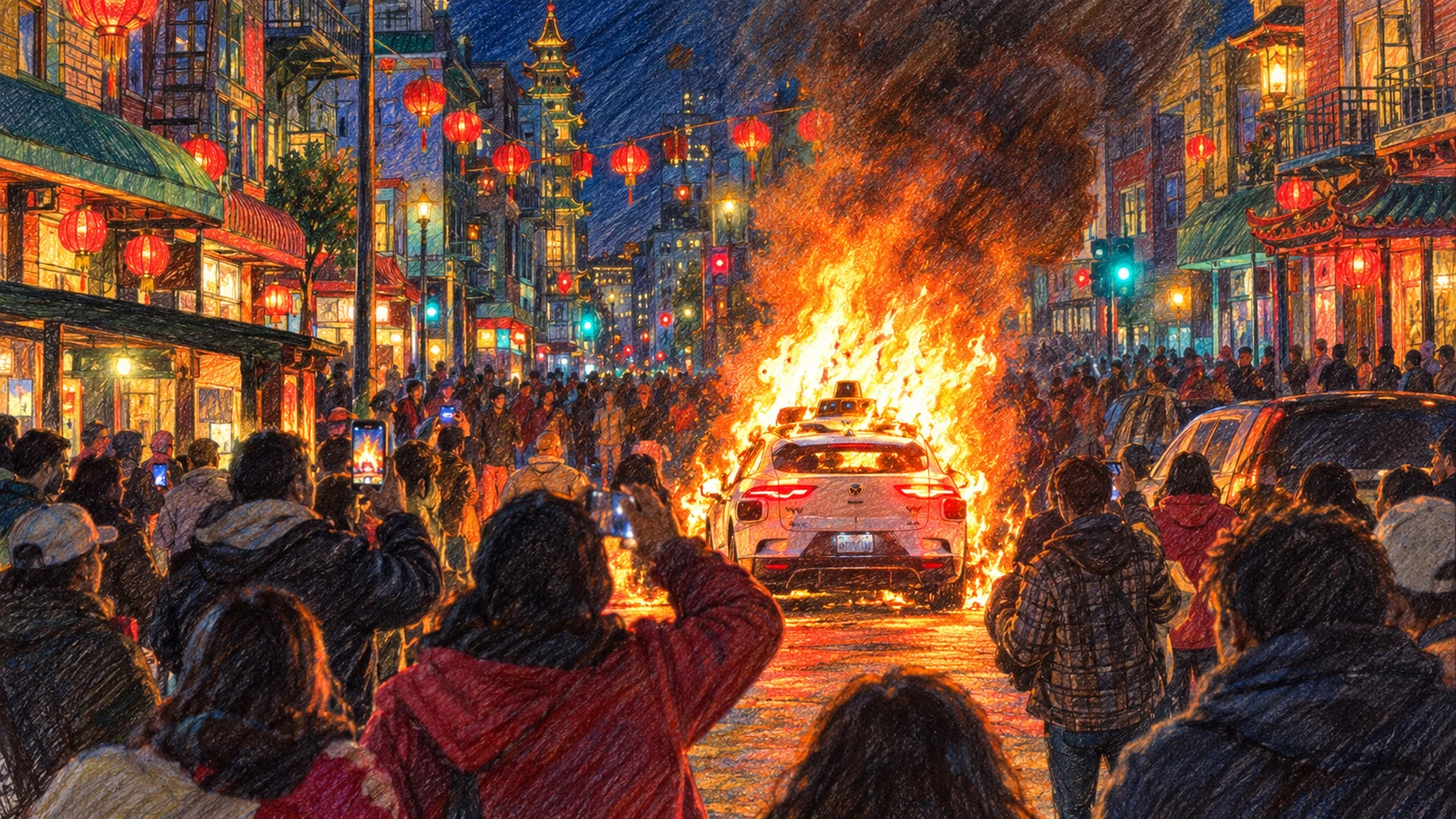
On Lunar New Year, flames rose above an empty Waymo on Jackson Street as people recorded on their phones. Some cheered. The footage spread far beyond Chinatown, where it drew jokes about robots, arguments about San Francisco and questions about why a driverless taxi had entered the gathering. Back on the street, firefighters had a burning car to put out, and police had an arson case to investigate.
The destruction happened on February 10, 2024, near Grant Avenue and Jackson Street. The San Francisco Standard’s reporting that night described broken windows, graffiti and a firework inside a Jaguar I-PACE. Waymo said the vehicle had finished a passenger drop-off and was heading toward another pickup. Nobody was riding in it, and no injuries were reported.
Why did an empty taxi attract that kind of attention? What happened to the businesses around it as the footage spread online? And did the fire change how Waymo or the city operated? More than two years later, witness accounts, dispatch records and subsequent decisions help answer those questions. They also show how much of the debate was already underway before anyone broke the car’s windows.
On Jackson Street
Michael Vandi, who filmed the scene, described the escalation to Reuters: one person jumped onto the hood and broke the windshield; another followed roughly thirty seconds later. People applauded. Some encouraged the damage, while others watched in disbelief and recorded it. The reaction was mixed even among people standing close enough to see the car.
“That was when it went WILD.”
Vandi’s account describes people encouraging the damage alongside shocked bystanders. In his recordings, people crowd around the car with their phones raised. The footage catches several reactions at once; it cannot tell us what each person intended.
happening NOW in SF. Waymo car vandalized & lit on fire 🤯
Michael Vandi (@michael_vandi) · February 10–11, 2024
Peter Yu of Dick Lee Pastry Shop told The Standard human drivers escaped the gathering while the Waymo stopped. He photographed it at 9:03 p.m. and called police at 9:06. His account does not establish what the software knew.
“There were so many people on the street at the time.”
The fire happened during February 10 street celebrations, before the city’s official Lunar New Year parade. The first night’s coverage placed it on Jackson near Grant. That setting matters to the question of why the car was there: this was a street gathering rather than the later scheduled parade. The vehicle’s exact routing instructions have not been established.
The dispatch record behind the footage
The dispatch record and SFPD’s April arson update share a case number: 240091235. The DataSF entry for CAD 240412954 lists PD240091235 as its associated report, with Grant and Jackson as the intersection. The case number ties this call to the investigation; its time and location also fit the reported scene.
February 10, 2024 · local dispatch times
- 9:01:24 p.m.
- Police call received; CAD 240412954.
- 9:03:29 p.m.
- Separate fire-service call received; call 240412955.
- 9:04:31 p.m.
- Police dispatch and en-route timestamps.
- 9:07:37 p.m.
- Engine 2 marked on scene in the fire record.
- 9:09:52 p.m.
- Police on-scene timestamp.
- 11:12:32 p.m.
- Police dispatch entry closed.
Sources: police dispatch and fire unit records. These are recorded workflow times, not a frame-by-frame reconstruction.
The police entry began as code 528, “FIRE,” with “ARSON” in its original notes. Its final classification is code 594, “VANDALISM.” The original and final priorities are both A. These are dispatch fields: they describe how the call was logged and handled, not a prosecutor’s decision or a court’s finding. A final vandalism label does not erase the separate arson investigation.
The fire-service dataset records call 240412955, incident 24021069, as a vehicle fire at the same intersection. Its five rows cover assigned units, each with its own timestamps. Engine 2 was dispatched at 9:03:38 p.m. and marked on scene at 9:07:37. These records let readers follow the response unit by unit, rather than treating every entry as another incident.
The official timestamps differ. SFPD’s later release says approximately 8:50 p.m.; the dispatch entry begins at 9:01:24, and the February 14 Police Commission minutes describe the incident at 9:01. The available records do not explain the difference. They do not establish when the vandalism began or when an officer first witnessed it.
At 11:12 p.m., the police dispatch entry closed. That timestamp marks the end of this entry, rather than the end of the criminal investigation. It also gives no extinguishment time. For that part of the night, the footage and fire-service records describe more than the police closing field alone.
The two agencies’ receipt times are two minutes and five seconds apart. Within each workflow, the interval from receipt to the listed on-scene time is eight minutes and twenty-eight seconds for police and four minutes and eight seconds for Engine 2. Those calculations describe these entries alone. They are not a comparison of departmental response performance: the calls were received at different times and assigned through separate systems.
A query of the public incident-report dataset for case 240091235 returned no rows when checked. The dispatch entry and SFPD’s release both name the case, but the missing result leaves us without a separate report narrative from that dataset. The reason is unclear. The available account therefore rests on the dispatch records, the official update and the reporting from the scene.
The damage beyond the robotaxi
The damage extended beyond Waymo’s vehicle. In the Police Commission’s minutes, Chief Bill Scott reported that a car parked beside it sustained moderate damage from the heat. The robotaxi supplied the headline image, but someone else’s car was damaged on Jackson Street too.
Waymo Vehicle surrounded and then graffiti’d, windows were broken…
San Francisco Fire Department (@SFFDPIO) · February 11, 2024
The Standard reported that nearby shopkeepers wanted traffic rerouted and Mayor London Breed condemned the danger to homes and businesses. For the shopkeepers, the problem included how cars had been allowed to enter a street crowded with people and fireworks.
The empty car made an easy subject for jokes. There was no passenger to picture escaping it, and the company could replace a vehicle. Nearby businesses had the fire on their doorstep. Yu witnessed the scene as he was closing his pastry shop; another car owner was left with damage. Nobody was reported injured, but the consequences reached people who had nothing to do with the attack.
Frisco Live 415 uploaded a longer recording from the scene. Its views of the burning car and the response give the episode more room than a still image or a short repost. It is one of several original recordings collected here, alongside Vandi’s clips and SFFD’s photographs, so readers can see where the accounts overlap.
How a fire became an internet argument
Some reactions treated the incident as science fiction happening in public. Matthew Yglesias joked about robots rebelling. Aravind Srinivas condemned the destruction and called for respect for Waymo. Their posts show how quickly the same footage could prompt a joke from one viewer and anger from another.
Why would the robots rebel?
Matthew Yglesias (@mattyglesias) · February 11, 2024
This is just sad. SF deserves better people. And Waymo deserves a lot more respect.
Aravind Srinivas (@AravSrinivas) · February 11, 2024
On r/sanfrancisco, the comments supplied miniature punch lines: “At least the hazards are on,” “Can’t park there, mate,” and “Way Mo Fire.” The humor reduced a dangerous event to a familiar broken-car joke. The same discussion contained anger about the destruction and questions about what happened. A thread can hold several reactions without resolving which is most common outside it.
Technology writer Brian Merchant argued that dismissing the attackers as unthinking ignored resentment toward Big Tech and the deployment of driverless cars in communities. In his post, the fire became part of a broader argument about who gets to put new technology on public streets. He was offering a political explanation, rather than an eyewitness account of the attackers’ motives.
“They ignore how much anger there is at big tech right now…”
Brian Merchant (@bcmerchant) · February 11, 2024
Safe Street Rebel told The Standard it was “not a Safe Street Rebel action,” but connected hostility to street access and surveillance. USF’s Billy Riggs called it “sheer urban violence.” Neither interpretation proves a common motive.
The same recording became an argument for critics, a grievance for supporters and a joke for others. To critics, a burning robotaxi could illustrate their anger at companies claiming space on public streets. To supporters, it showed a useful service being attacked. The jokes needed no position on permits or safety research. Each reaction gave the clip a different meaning, while the people living and working near the fire had more immediate concerns.
Techmeme’s archive from that week collects the reporting and several of those reactions. The selected posts show what their authors said, rather than how Chinatown as a whole felt. They offer no measure of whether riders changed their behavior or whether the jokes encouraged later attacks. The argument was visible online; its effect on trips and street behavior is harder to establish.
Waymo kept operating
Reuters reported Waymo would continue serving riders the next day. Company spokesperson Sandy Karp told The Standard the car encountered a pop-up street fair after a drop-off and people rushed it. That account does not disclose its routing instructions.
An operator has legitimate reasons to avoid drawing fleet-wide conclusions from an attack on one car. Intentionally breaking windows and setting a vehicle on fire is different from a vehicle causing a collision. Yet the operator also controls routing, remote support and recovery procedures. The useful question is whether those systems reduce exposure when an ordinary trip encounters an extraordinary crowd.
That question cannot be settled by a promotional slogan or a burning-car clip. A stopped vehicle might avoid hitting a pedestrian while remaining vulnerable to people damaging it. A decision to move might create another danger. Without the vehicle’s detailed logs and the surrounding sequence, an outside observer cannot reliably say which available maneuver would have been safe.
There is quantitative evidence for Waymo’s broader safety case. Researchers from Waymo and Swiss Re analyzed 25.3 million driverless miles, reporting 88% fewer property-damage liability claims and 92% fewer bodily-injury claims than their overall human-driver benchmark. Against a newer-vehicle benchmark, the reported reductions were 86% and 90%. Those comparisons concern insurance claims in the study’s operating conditions; they do not establish immunity to arson.
Waymo helped write the study, which did not examine encounters with hostile crowds. Its findings still leave the Chinatown routing question open: how did this car reach the gathering, and what choices did it have once people surrounded it? A safer driving record would not, by itself, explain how an operator should get a car out of that situation.
Privacy is another part of the dispute. In an August 2026 statement, Waymo said its cameras serve driving and mapping functions rather than facial identification. It also said it complies with legally authorized law-enforcement requests and may challenge overly broad ones. The statement describes the company’s policies at that time; it does not disclose what evidence investigators received in the Chinatown case.
A camera can help investigate an attack while also raising questions for people filmed during ordinary street life. Those uses are not mutually exclusive. The relevant questions concern access, retention and legal limits, rather than whether the car looks friendly or threatening. No record reviewed here establishes that surveillance concerns motivated the people who damaged this particular vehicle.
A recall announced three days after the fire had a separate history. Waymo’s February 13, 2024 notice concerned two December collisions in Phoenix: two of its cars hit the same improperly towed pickup minutes apart. Waymo said the vehicles had incorrectly predicted the motion of the pickup, which was facing backward while being towed. It reported minor damage and no injuries. The software fix reached the fleet between December 20 and January 12, before Chinatown. The notice addressed a driving problem discovered in December, rather than a repair prompted by the February attack.
A mistaken arrest report, then a juvenile suspect
In March, SFPD gave The Standard information about a separate Tesla-arson arrest when the outlet asked about Chinatown. After publication, the department said it had confused the cases. The Standard corrected its report: the arrested man was not a suspect in the Waymo fire. The corrected account is an important part of the case’s history.
On April 17, SFPD announced a different development: investigators had identified a fourteen-year-old boy and served a search warrant at his residence on March 27, seizing evidence. The release said the District Attorney’s Office had filed charges and that juvenile probation would determine whether he would be arrested or appear in court out of custody. The same notice also called a charge forthcoming; it did not include a charging document.
The announcement reported progress in the investigation, rather than a completed court case. A final juvenile court outcome could not be verified for this article. The March correction and April update concern different people, and the public account should keep them separate. The boy’s suspected involvement also does not identify everyone who damaged the car or explain the entire crowd’s behavior.
The policy debate continued after the fire
The immediate regulatory outcome was not a shutdown. On March 1, 2024, the California Public Utilities Commission approved Waymo’s updated passenger-safety plan for expansion into parts of Los Angeles and the San Francisco Peninsula. The application had been filed January 19. The approval followed the fire, but the process had begun before it.
The decision also records objections from local agencies and other organizations about public safety, oversight and first responders. CPUC staff treated several broader policy arguments as outside that advice-letter review’s scope. That distinction helps explain the frustration: a question residents consider central to street safety may belong to a different regulatory proceeding from the one approving an expansion.
Waymo’s San Francisco business continued expanding. Its June 25, 2024 announcement ended the invite requirement and opened the service to anyone using the app. The company was widening access four months after the fire. That development sits alongside the hostility in the February footage: Waymo kept operating and seeking riders while arguments over its place in the city continued.
Local-control legislation also predates the attack. Senator Dave Cortese announced SB 915 on January 9, 2024, seeking a larger role for cities in governing driverless services. Its supporters argued that communities needed authority over vehicles using their streets. The proposal therefore cannot accurately be described as a bill created by the February fire.
SB 915 did not become a local-permitting law. A later Senate committee analysis records that it was held in the Assembly Transportation Committee. A different measure, AB 1777, authored by Phil Ting, became law in 2024. Its focus was on first-responder interactions and a process for reporting traffic violations by vehicles operating without someone behind the wheel.
DMV’s explanation of AB 1777 describes authority for notices of AV noncompliance for alleged traffic violations, dependent on regulations, and additional first-responder interaction requirements beginning July 1, 2026, including two-way communication equipment. Those provisions address accountability when no human driver is sitting behind the wheel.
In April 2026, DMV adopted broader AV regulations covering emergency communication, enforcement and operational oversight. Its announcement describes a thirty-second response requirement for first-responder calls and electronic emergency geofencing: local officials can identify restricted areas, and fleets must leave emergency zones. The package also includes stronger reporting and permitting standards; provisions have different implementation dates.
These rules address problems raised during the debate around the fire, including emergency access and who can direct a fleet away from trouble. The cited announcements do not identify the Chinatown attack as their direct cause. The dates tell a broader story: local-control proposals preceded the fire, and new statewide responsibilities developed afterward, during an ongoing argument over how driverless services should operate.
San Francisco pursued a court challenge as well. The Transportation Authority’s February 2025 report says the city’s lawsuit was filed in December 2023, seeking more thorough public-safety review and safeguards around unrestricted commercial service. It reports that the appellate court upheld CPUC’s action on January 14, 2025. That proceeding, too, began before Chinatown; its result concerns regulatory approval, not guilt in the arson case.
Waymo later announced operational changes after San Francisco’s December 2025 PG&E outage. It acknowledged that delayed remote confirmations contributed to congestion and announced fleet updates for outage context and improvements to emergency procedures. That announcement ties the changes to the blackout, nearly two years after the Chinatown attack.
The company, city and regulators took different paths through this period. Waymo opened its service more widely. San Francisco challenged the approvals in court. State officials added requirements for emergency response and oversight. Those decisions have more practical effect on future trips than the online argument alone: they concern where cars can operate and what happens when authorities need them moved.
More Waymos burned in the years that followed
The Chinatown vehicle was not the last Waymo to burn. The FBI and ATF investigated deliberate fires in downtown Los Angeles on June 8, 2025, describing people igniting and pouring an unidentified substance around Waymo vehicles near Los Angeles Street. The agency’s notice estimates damage at $215,000 per vehicle. That estimate belongs to the Los Angeles investigation, not the Chinatown car.
TIME’s coverage places those attacks amid protests over immigration enforcement and reports a temporary service suspension in the affected area. The political setting differed from the Lunar New Year gathering. Similar footage of burning white robotaxis cannot establish the same participants, motives or organizational connection between the two events.
On September 26, 2025, ABC7 Los Angeles reported a backseat fire in Mar Vista. Its initial account said the cause and whether anyone had been inside were unclear. The report documents another burned vehicle, but leaves open what started that fire. It belongs in the history with that uncertainty attached, rather than under an assumed cause.
San Francisco had another fire on July 4, 2026. The Chronicle reported Waymo’s account that an unoccupied car burned after driving over a firework near the 1200 block of Connecticut Street, with no reported injuries. It separately described a vehicle with passengers encountering a lit firework. Those are distinct incidents; the passenger clip should not be used as footage of the empty car’s fire.
These reports describe deliberate attacks, an unexplained cabin fire and a reported encounter with a firework. They are selected incidents, rather than a nationwide count. Each deserves follow-up on its own terms: who caused the damage, whether anyone was exposed to danger, how the company responded and what investigators learned. A similar-looking photograph is only the start of that reporting.
The unanswered questions
Several consequential records remain outside this account: a complete reconstruction from the vehicle’s logs, an independently documented explanation of its routing and recovery decisions, and a verified final court outcome. The public dispatch entry cannot supply them. Nor can the loudest replies under a video.
The question for the company is how it handles a street that changes faster than a trip plan. For the city, it is how crowd management, emergency access and regulatory authority work together before a gathering becomes an incident. For critics and supporters, it is whether their preferred interpretation leaves room for evidence that complicates it.
The burning car is the image most likely to endure. The less visible parts of the story include Yu closing his shop, damage to another parked car, the correction to an arrest report and the later changes in oversight. For the next crowded celebration, the practical question is still open: who spots the problem, who can keep traffic out, and how quickly can an operator get its cars away?